
One of the saddest sights in Okinawa is the beaches. This being a sub-tropical island, the weather is warm to hot most of the year, and if you pick up a travel brochure, or click online, you’ll see countless glorious images of pristine golden-sanded beaches. It’s no lie, they really do exist here in Japan’s southern-most prefecture. The deception, however, is in the selection. Beaches cornered by large resort hotels, the majority of which are public, tend to be well-maintained and fulfil the package-holiday makers expectations: sands are gold(ish), and seas are blue (ignoring days of dark clouds, and typhoons).
However, venture to one of the many natural beaches, or at least any unconnected to someone’s direct monetary gain, and you will, perhaps, be as disheartened as I when I first arrived here a decade or so ago. For the curse of our generation blights what should be a haven for wannabe Robinson Crusoe’s: rubbish, also known as trash, or, as it’s called here, gomi. There is tonnes of it, and I don’t think that is mere hyperbole. Some of the worst affected beaches have a little of the municipal waste dump about them.

Swept up by the Pacific currents, the modern day flotsam and jetsum of the shipwreck some call progress settles all around the island. Some beaches are only slightly impacted but others along the coastline are unfortunately positioned to act as a kind of scoop pulling in whatever detritus happens to be out there. Fishing buoys, plastic bottles, shoes and endless identity-unknown bits of plastic are washed up.

Nowhere on this planet seems immune to humanity’s discards, of course, so it would be naive to be surprised by the sight of another PET bottle lying in the sand. Yet, we still buy into the mythology of a barren beach awaiting our singular print in the sand and an escape from the industrial pressures of our everyday lives. It doesn’t exist. Humans are everywhere and where we’re not, our rubbish got there ahead of us, carried along by the globe-networking currents of the world’s oceans.


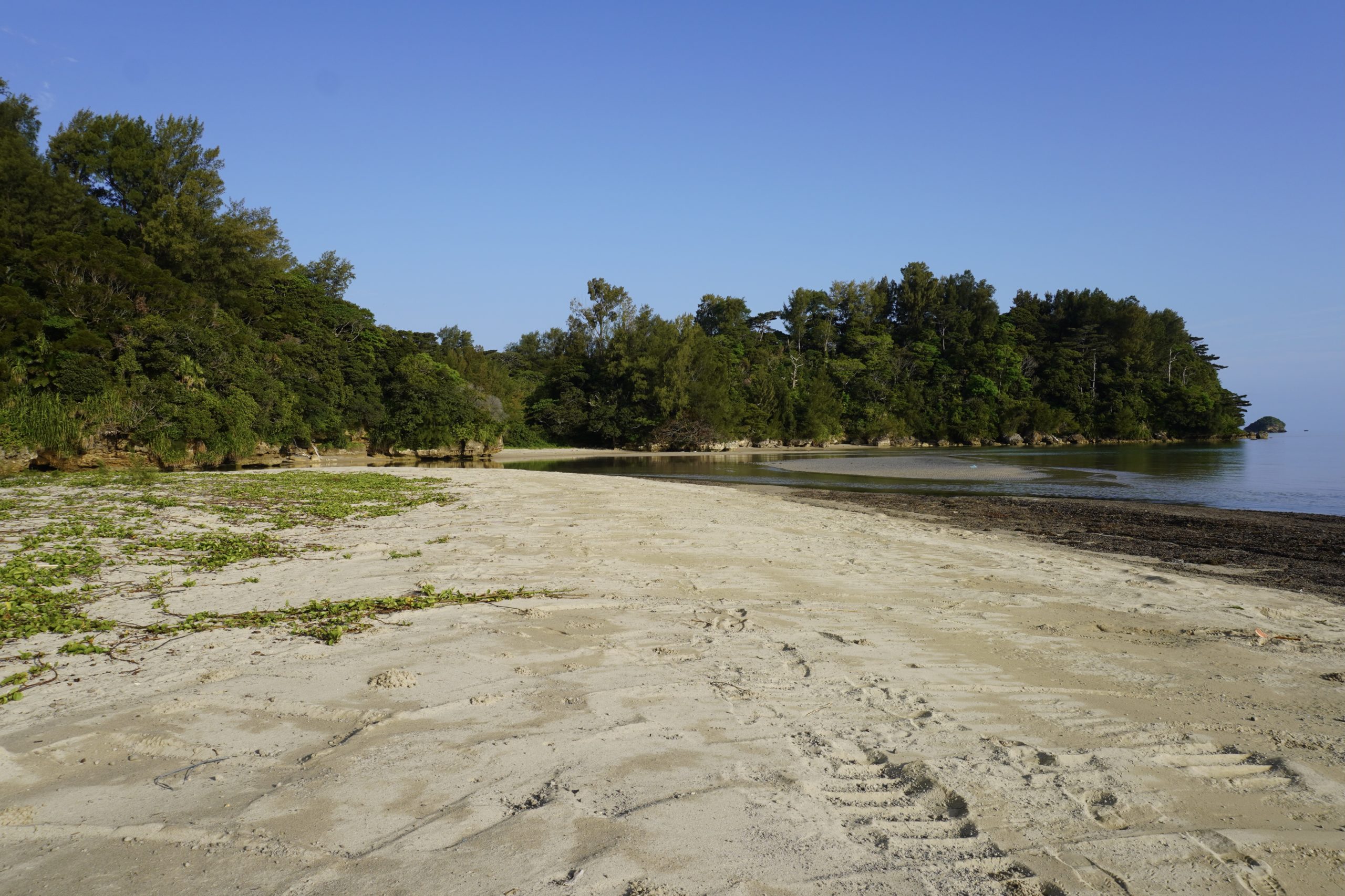
However, though the presence of gomi is no longer a shock when I pootle off to my local Okinawan beach, it’s absence strangely, and delightfully, is. And so it was on this morning’s (rare) walk. As I approached the path leading to a beach which forms one side of a narrow channel in the Haneji inland sea (羽地内海), I was stopped in my tracks by a sign which said No Entry in Japanese (立ち入り禁止). A team of what looked like construction workers seemed to be getting ready to start work so I asked one if it was really ‘no entry’. Of course, no, it wasn’t, otherwise there would be no beach to have seen and for me to be surprised by, or write about. Anyway, I got down to the beach and discovered those said same workers had been busy cleaning up the whole beauty spot and it was now near pristine.
Pumice peril
I don’t believe the workers had come there for the trash. As has been reported, pumice thrown up by an undersea volcanic eruption in the Ogasawara island chain back in December 2021 has been smothering beaches across the Pacific for many months. It was a stony mess that has gradually, naturally and with human assistance, mostly cleared. During its peak arrival, the pumice turned shorelines grey, clogged ports and boat engines, killed sea life and heavily impacted livelihoods dependent on the sea.

Teams of volunteers, and staff from hotels, as well government task forces, took part in clean ups all over Okinawa and hundreds of hefty one-tonne builders bags could be seen all along the island’s beaches filled and piled together awaiting removal. Some of the pumice even made its way onto farmers’ fields as a form of fertiliser, while numerous ideas were put to the prefectural government on how the stones could be utilised. The clean up is expected to cost more than 1.6 billion yen (13.5 million US dollars), and this does not include the economic damage to tourism and fishing. In addition, no numerical value seems to have been placed upon the cost to the natural world within the ocean.


It was one of those prefectural clean up teams that I happened upon during my stroll this morning. I suspect they had come for the pumice. The Okinawa governor Denny Tamaki had himself visited Nago in October to take a look at the state of the beaches, so perhaps this was no coincidence. However, as this beach was previously heavily littered with all kinds of washed up trash, which had become mixed in with the pumice, I guess they decided to take the lot, stones and gomi alike. For which I thank them. I just hope they come back soon, regardless of pumice, because this beach looks so much more glorious and inviting without Polyethylene and its polymer relatives basking in the sun.

