
Fish. They don’t do much, do they? They swim, they eat, they get eaten (unless apex, and even then they’re prey to humans) and mate. But mostly they swim. What could there be to see? Yet we do love to watch them swim around, don’t we? There must something intrinsically fascinating about the graceful push through saline that human eyes cannot resist. We like looking at fish go round, and round, and round. Why else would so many people buy fish tanks and take so much care looking after the exotic specimens we drop inside? In fact, more than one billion tropical fish are sold worldwide annually – some bred, most caught (most of which die before reaching the retailers). However, tropical fish tanks, as anybody who has ever owned one will contend, require a lot of care or the inhabitants easily bite the big one. And, if we’re willing to face the unpleasant truth, keeping tropical fish in a tiny glass box in your living room is very much not the kindest of things to do.

Which is why, perhaps, public aquariums are all the rage. At present there are said to be more than 200 aquariums (aquaria, if you like) or marine life centres across the planet, and every region looking to prove its global credentials – China, Dubai, and Singapore among the most recent – seems to be opening one. Each aquarium attempts to offer something bigger or different, or to trump previous record-holders (biggest tank, most species and other such kudos enhancers), but, ultimately, they are all just putting more fish in tanks for us to watch swim around and around, and around. Take Okinawa’s Churaumi Aquarium.
Size matters
Back in 2002, after 13,897 names were suggested in a nationwide competition, Okinawa Churaumi (Beautiful Sea) Aquarium was opened at the Ocean Expo Park Area, home to Expo ’75 and its former aquarium, on the Motobu Peninsula on Okinawa’s main island. The new aquarium with its dolphin show (Okichan Theater) soon became one of the prefecture’s most impressive tourist magnets, attracting more than three million visitors annually. For a few short years the site even held the coveted crown of the biggest aquarium in the world. Yes, the world – until trumped by the USA’s Georgia Aquarium in 2005, which itself lost the title in 2012 to Singapore, which then subsequently lost the crown to China’s Chimelong Ocean Kingdom in 2014. As I said, size does seem to matter to some folk.

However, Churaumi remains impressive regardless of Guinness World Records rankings when you consider its home is a tiny island 1,500 km south of Tokyo and only 112 km-long from north to south. The island actually runs along the line where the Pacific Ocean meets the East China Sea, which perhaps makes Churaumi an appropriate place to learn more about ocean life below the surface. It is home to a huge and incredibly successful collection of fish tanks and still maintains one of the best collections of marine life anywhere on the planet (bar the actual sea itself, which still has a lot of life, we hope).
Tanks, but no tanks
The pretty coral beds that have been grown from tiny translucent polyps to colourful colonies are the first thing visitors will be drawn to on entering Churaumi Aquarium’s main building and are a good indication of what lives in the shallower waters surrounding the island. And it’s the logical place to start a tour of Churaumi as the coral reefs are the essential factor for sustaining the variety of sea life up the entire food chain in these and any tropical waters (in fact, as much as one quarter of all sea life is estimated to be dependent on coral reefs for shelter and food). And it’s this food chain that the aquarium will take you through: from coral to crustaceans, including the Japanese spider crab (the largest crab in the world), small fish to big fish and then onto the largest fish of all: the whale shark (again with the size thing). The main building is designed to take you on a tour from the beach to the deep sea, where darker habitats reveal sea life rarely seen by humans, and replicating the actual sea around Okinawa which drops to depths of 700 meters on either side.
Naturally, no one has dug down 700 meters to build such a large tank, but the one they do have for this demonstration of the deep is pretty darn big. At 8.2 meters high, 22.5 meters wide, and made with 60cm thick acrylic windows the Kuroshio (Black Currents) Sea Tank holds 7,500 cubic meters of water. That’s probably plenty of space for your goldfish, but perhaps the actual, larger inhabitants would argue, if they had such a facility to converse with human interlocutors, that it’s not quite as big as the place they were pulled from.
Although the tank is bursting with about 60 different species, including hypnotic manta rays ‘flying’ around, the main attractions are the two whale sharks. These eight metres-long fish, which can grow above 12 metres, spend their days swimming in small circles while goggled and flash-photoed by tiny land dwellers when they would usually be swimming thousands of kilometres on their natural migratory path, occasionally accompanied by pilot fish or some other oceanic hanger-on. It’s something of a comedown for such a majestic creature that may live more than 100 years, but nonetheless an impressive sight for thousands upon thousands of humans who come to see them every year.

Not quite Jaws
In another large, but not so intimidating tank, reside some not so large but definitely intimidating fishes. It’s not to say these fellas are the most dangerous things on our planet, statistically-speaking, but facts don’t help when your dipping your toe in the sea. Yes, it’s the man-eaters. Okay, okay, the potential man-eaters. The scary chaps who could, if they so chose, make you dinner (but they probably wouldn’t). I’m talking about long-bodied, sharp-toothed, large-mouthed sharks: bulls, tigers and sicklefin lemon sharks for instance. These powerful hunters circle their own tough-guy tank ominously passing their humourless eyes in your direction, and smaller fish are only allowed to enter at feeding time – if you catch my drift. Sadly these apex predators are under more threat from us than us from them, which is something else you may be able to learn about in the interactive Shark Research Lab where their tank is situated and where Japan’s first captive lemon shark was successfully born.
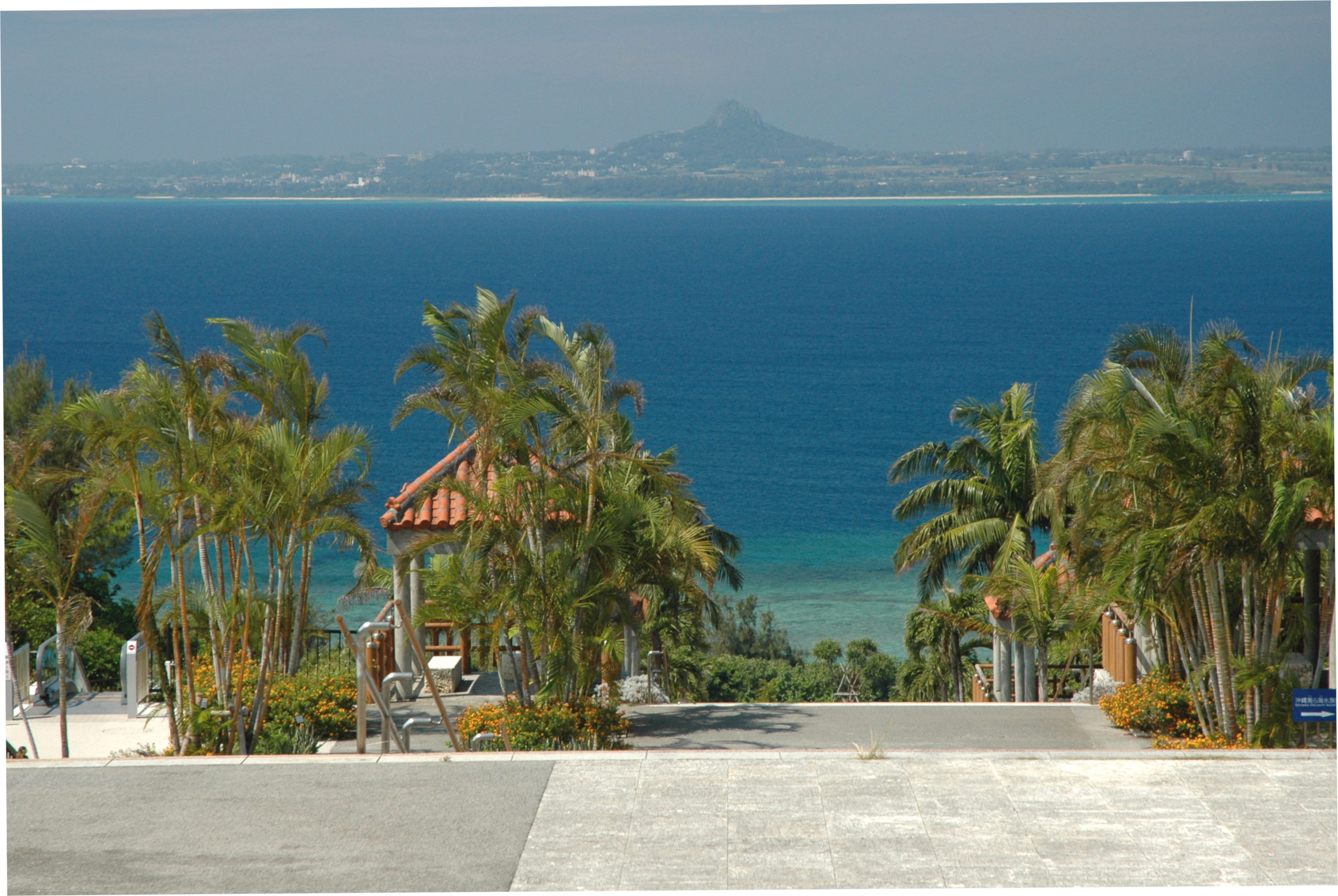
But it’s not all about these large tanks, impressive as they are. Or even the equally captivating smaller tanks with all kinds of life forms only a marine biologist could name. In fact, the aquarium itself is only one small part, although still the main attraction, of the very large Ocean Expo Park that sits snugly along the picturesque coast of Motobu in the north of the island. Outside the main building there’s more than enough to fill a day, or possibly two. In the actual aquarium grounds there’s a turtle pool, with a breeding programme for a couple of endangered species; another watery enclosure with zen-like manatees from Mexico; and then you’ve got the Oki-chan Theater with the obligatory jumping dolphins show all set like some hotel resort infinity pool overlooking the Pacific Ocean. It’s not hard to be impressed, if you’re not uncomfortable with our fellow Earthlings being caged, or rather tanked.
Building on Okinawa’s past
The Expo Park started life as a legacy of Expo ’75, held, in part, to commemorate the official end of the USA’s occupation of Okinawa in 1972, and has since become a beacon of tourism possibilities for the beleaguered Ryukyu archipelago. Here is an example of what the island could do if it just had more space, that is, fewer military bases, and the right kind of support from those up yonder in the big smoke, that is Tokyo. Okinawa is already popular as a tourist destination, mostly with Japanese and Chinese visitors, but the park hints at just how much more could be done to raise the prefecture’s profile and become a magnet for tourism in the Pacific.
In the areas of the park that aren’t about sea there are sites that get less of a fanfare. This does them a disservice because, stepping aside the somewhat misleading name, the Tropical Dream Center alone is worth a few hours for a quiet stroll of any cerebral tourist’s time. It’s a tranquil site of sub-tropical plants in gardens and greenhouses with carp ponds, hanging plants, a spiralling brick tower and other peculiar follies, as well as a whole lot of orchids.

In a similar vein, the Tropical and Subtropical Arboretum is the place to learn about Okinawa’s tree life; the Culture Museum and Planetarium offer an insight into the people and the skies; and the traditional Okinawan village gives you a glimpse into the homes of old. All worthwhile alternatives to fish in tanks.


What’s at Ocean Expo Park, Okinawa
You can get into the park and see a number of areas for free, including, rather surprisingly, the dolphin show. Fees apply for the aquarium and one or two other sites:
Ocean Zone
- Churaumi Aquarium
- Emerald Beach
History and Culture Zone
- Oceanic Culture Museum (and Planetarium)
- Native Okinawan Village and Omoro Arboretum
Flowers and Greenery Zone
- Tropical Dream Center
- Tropical & Subtropical Arboretum
Getting there
Regular buses run from Naha, or hire a car and head up Route 58 – it’s signposted all the way.
